 Steve Gravrock
a497d0942a
Steve Gravrock
a497d0942a
It's very easy to forget to `await` or `return` the promise returned
from `expectAsync`. When that happens, the expectation failure will
occur after the spec or suite's result has been reported to reporters,
and the failure will typically not be shown to the user. This change
adds a top-level suite failure in that case, similar to the way we
report unhandled exceptions or promise rejections that occur after the
runable completes. Adding the error at the top level gives us the best
chance of getting in before the set of failures we add it to is sent
to reporters.

See #1752.




A JavaScript Testing Framework
Jasmine is a Behavior Driven Development testing framework for JavaScript. It does not rely on browsers, DOM, or any JavaScript framework. Thus it's suited for websites, Node.js projects, or anywhere that JavaScript can run.
Documentation & guides live here: http://jasmine.github.io For a quick start guide of Jasmine, see the beginning of http://jasmine.github.io/edge/introduction.html
Upgrading from Jasmine 2.x? Check out the 3.0 release notes for a list of what's new (including breaking changes).
Contributing
Please read the contributors' guide
Installation
For the Jasmine NPM module:
https://github.com/jasmine/jasmine-npm
For the Jasmine Ruby Gem:
https://github.com/jasmine/jasmine-gem
For the Jasmine Python Egg:
https://github.com/jasmine/jasmine-py
For the Jasmine headless browser gulp plugin:
https://github.com/jasmine/gulp-jasmine-browser
To install Jasmine standalone on your local box (where {#.#.#} below is substituted by the release number downloaded):
- Download the standalone distribution for your desired release from the releases page
- Create a Jasmine directory in your project -
mkdir my-project/jasmine - Move the dist to your project directory -
mv jasmine/dist/jasmine-standalone-{#.#.#}.zip my-project/jasmine - Change directory -
cd my-project/jasmine - Unzip the dist -
unzip jasmine-standalone-{#.#.#}.zip
Add the following to your HTML file:
<link rel="shortcut icon" type="image/png" href="jasmine/lib/jasmine-{#.#.#}/jasmine_favicon.png">
<link rel="stylesheet" type="text/css" href="jasmine/lib/jasmine-{#.#.#}/jasmine.css">

<script type="text/javascript" src="jasmine/lib/jasmine-{#.#.#}/jasmine.js"></script>
<script type="text/javascript" src="jasmine/lib/jasmine-{#.#.#}/jasmine-html.js"></script>
<script type="text/javascript" src="jasmine/lib/jasmine-{#.#.#}/boot.js"></script>
Supported environments
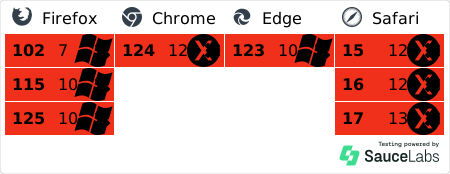
Jasmine tests itself across many browsers (Safari, Chrome, Firefox, Microsoft Edge, and new Internet Explorer) as well as nodejs. To see the exact version tests are run against look at our .travis.yml
Support
- Search past discussions: http://groups.google.com/group/jasmine-js
- Send an email to the list: jasmine-js@googlegroups.com
- View the project backlog at Pivotal Tracker: http://www.pivotaltracker.com/projects/10606
- Follow us on Twitter: @JasmineBDD
Maintainers
- Gregg Van Hove, Pivotal Labs
Maintainers Emeritus
- Davis W. Frank, Pivotal Labs
- Rajan Agaskar, Pivotal Labs
- Greg Cobb, Pivotal Labs
- Chris Amavisca, Pivotal Labs
- Christian Williams, Cloud Foundry
- Sheel Choksi
Copyright (c) 2008-2018 Pivotal Labs. This software is licensed under the MIT License.
License